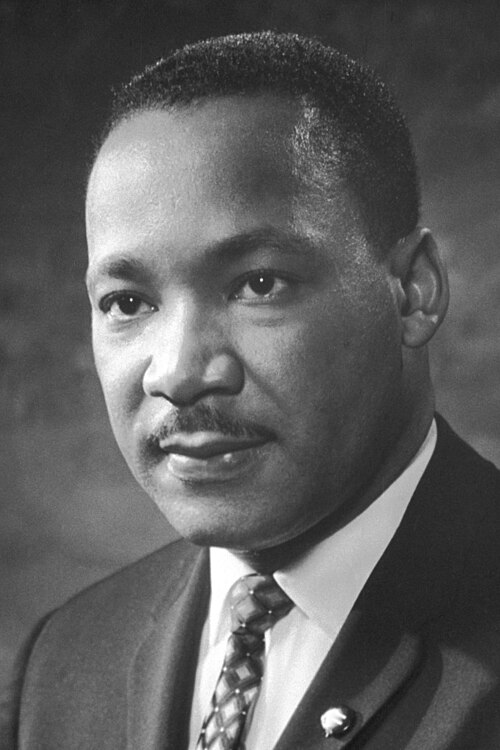
When we think about the fight for civil rights in America, one name always rises to the top: Dr. Martin Luther King Jr.His life was short—just 39 years—but his impact reshaped the country. King believed in the power of love and nonviolent resistance, and through that belief he inspired millions to stand up for justice.
Growing Up in the South
Martin Luther King Jr. wasn’t always “Martin.” He was born Michael King Jr. on January 15, 1929, in Atlanta, Georgia. His father, a Baptist minister, later changed both of their names after a trip abroad, inspired by Protestant reformer Martin Luther.
King grew up in a segregated South where racism was a daily reality. One of his earliest memories of discrimination came when a white childhood friend told him they could no longer play together because of the color of his skin. His parents taught him to respond not with hate, but with love—lessons that shaped the man he would become.
King excelled in school, skipping grades and heading to Morehouse College at just 15 years old. He later studied theology in Pennsylvania and earned a Ph.D. in Boston, where he also met his future wife, Coretta Scott.
Marriage, Ministry, and Montgomery
Martin and Coretta married in 1953 and eventually had four children. In 1954, King accepted his first pastorate at Dexter Avenue Baptist Church in Montgomery, Alabama.
The following year, Rosa Parks refused to give up her seat on a Montgomery bus. That small act of defiance sparked the Montgomery Bus Boycott, and King—still new to town—was chosen to lead it. For over a year, Montgomery’s Black residents refused to ride the buses, facing harassment, violence, and economic hardship. King’s own house was bombed. But the boycott worked: in 1956, the Supreme Court struck down segregation on buses.
Almost overnight, King went from being a young preacher to the national face of the Civil Rights Movement.
Building a Movement
To harness this momentum, King and other ministers founded the Southern Christian Leadership Conference (SCLC)in 1957. Their mission was simple but powerful: coordinate nonviolent protests across the South.
King’s leadership carried him through some of the movement’s most pivotal moments:
- Birmingham (1963): King was arrested during protests and wrote his famous “Letter from Birmingham Jail,”reminding America that “freedom is never voluntarily given by the oppressor; it must be demanded by the oppressed.”
- March on Washington (1963): Before more than 250,000 people at the Lincoln Memorial, King delivered his “I Have a Dream” speech—a vision of racial harmony that still inspires today.
- Selma (1965): The world watched in horror as peaceful marchers were brutally attacked on “Bloody Sunday.” These events pushed Congress to pass the Voting Rights Act of 1965.
By this point, King had been arrested nearly 30 times, threatened countless more, and yet never wavered in his commitment to nonviolence.
Beyond Civil Rights
By the mid-1960s, King began to widen his focus. He opposed the Vietnam War, arguing that money spent overseas should be used to fight poverty at home. He also launched the Poor People’s Campaign, calling for economic justice and even proposing a universal basic income—a radical idea for its time.
His last book, Where Do We Go From Here: Chaos or Community?, laid out his vision for a more equal society.
Tragedy in Memphis
In April 1968, King traveled to Memphis, Tennessee, to support striking sanitation workers. On April 3, he gave his final speech, “I’ve Been to the Mountaintop,” where he spoke almost prophetically about not fearing death.
The next evening, April 4, King was shot and killed on the balcony of the Lorraine Motel. His assassination sparked riots in cities across America. He was only 39 years old.
The Power of Love and Nonviolence
At the core of King’s philosophy was the belief that love was stronger than hate. Inspired by Gandhi, King argued that nonviolence was not weakness—it was strength. The goal wasn’t to defeat your enemy, but to turn them into a friend.
He believed:
- Violence breeds more violence, but love can transform.
- Justice is inevitable—the universe bends toward it.
- Suffering for a cause can expose injustice and inspire change.
This wasn’t abstract theory. King lived it—marching, protesting, going to jail, and enduring threats—always without striking back.
Legacy
Today, King is remembered with a national holiday and countless streets, schools, and monuments bearing his name. But more than symbols, his true legacy lives on in the continued fight for racial justice, voting rights, and equality.
King asked not to be remembered for awards, but for trying to “feed the hungry, clothe the naked, be right on the war question, and love and serve humanity.” That’s how history remembers him—and why his dream is still alive.
✨ Martin Luther King Jr. wasn’t perfect, but he was profoundly human, courageous, and unshakable in his belief that America could be better. His story reminds us that change comes not from violence, but from the steady, unrelenting power of love and justice.