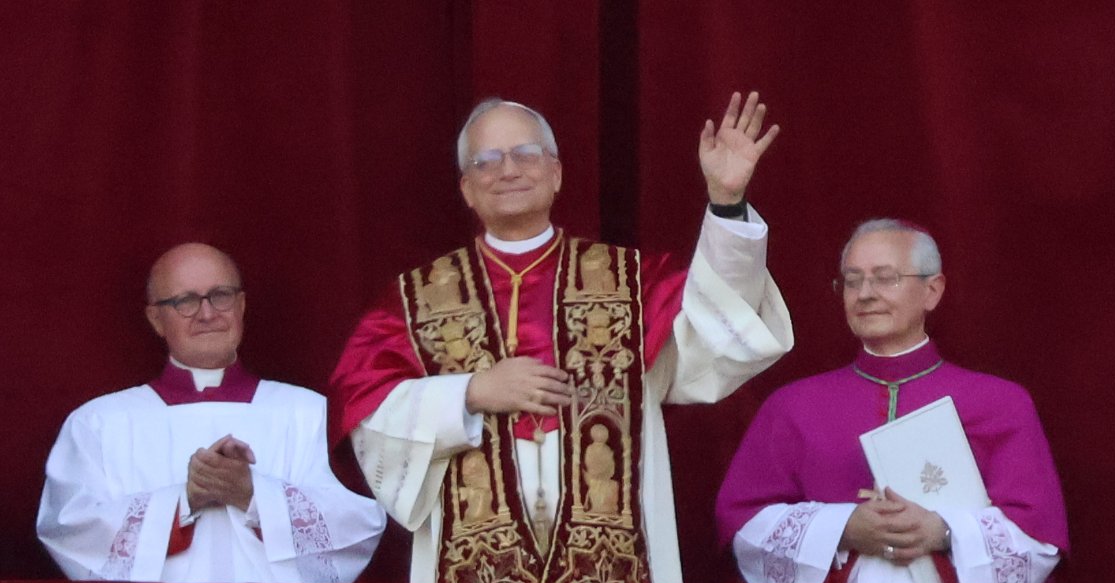
A person’s formative years can significantly shape their identity and future aspirations. The environment in which they grow up plays a crucial role in molding their social development and understanding of acceptable and unacceptable behaviors. Notably, our recent Popes have come from challenging backgrounds. Albino Luciani, Pope John Paul I, hailed from fascist Italy. Karol Wojtyła, Pope John Paul II, originated from Soviet-Communist-dominated Poland. Joseph Ratzinger, Pope Benedict XVI, came from Nazi Germany. Jorge Bergoglio, Pope Francis, hailed from a military junta-ruled Argentina. And now, we have Father Bob from Chicago.
Born in 1955, Robert Prevost— the future Pope Leo XIV— the first Baby Boomer Pope— might, like other Boomers, have memories of these events or their aftermath:
- America’s response to the USSR launching Sputnik, intensifying the teaching of math and science.
- The 1960 election of John F. Kennedy, the first Roman Catholic president. Every Catholic elementary school classroom had a statue of the Virgin Mary and a portrait of JFK.
- The 1962 Cuban missile crisis— when nuclear war was a very real possibility.
- The assassination of President Kennedy.
- The innovative social programs of Lyndon Johnson’s ‘Great Society’.
- The Civil Rights movement and its violent opposition.
- The war in Vietnam and its protests.
- The scientific achievement of the Space Race and NASA’s moon landing.
- The Watergate scandal and its cover-up.
Most members of the current College of Cardinals (who elected Cardinal Prevost as Pope) would have those same Boomer memories.mer memories.
More specifically, what would young Robert Prevost have experienced growing up in the Chicago metropolitan area? How will Pope Leo XIV’s Chicago roots inform his papacy?
As a young man, Bob Prevost might have visited these iconic Chicago institutions:
He could have visited the Art Institute of Chicago to admire religious artwork by renowned artists like Chagall, Rubens, Tintoretto, Manet, O’Keeffe, El Greco, and many others. Every year, the now-demolished International Amphitheatre, situated right next to the Union Stockyards (Ah! The aroma of the livestock!), hosted the Sportsman’s Show, a popular event hosted by actor John Bromfield. Audience members had the chance to challenge Victor the Wrestling Bear to a match. (Word of advice: if you ever get the opportunity to wrestle a bear, don’t.) He might have also visited the Chicago Auto Show at the original McCormick Place exhibition hall, named after Chicago Tribune publisher Colonel Robert McCormick. Unfortunately, the old McCormick Place burned down in 1967. The historic Chicago Stadium, which once hosted the Ice Capades and the pre-helmet era Chicago Blackhawks hockey team, stands as a testament to the city’s rich sporting heritage.
“Anywhere in the world you hear a Chicago bluesman play, it’s a Chicago sound born and bred.”
Ralph Metcalfe
The Earl of Old Town, a folk music venue, was a haven for Chicago music legends such as Steve Goodman and Bonnie Kolac. It was situated across the street from the home of The Second City improv troupe.
“Chicago Cubs fans are ninety percent scar tissue.”
George F. Will
You don’t have to be a Chicago Cub fan to appreciate Wrigley Field— one of baseball’s oldest ballparks, home of the lovable Loser Cubs (and, for a while, the Chicago Bears football team). No doubt young Bob spent time at old Comiskey Park, where organist Nancy Faust made even mediocre White Sox teams enjoyable. Faust mixed religion and baseball when she played ‘Jesus Christ Superstar’ as slugger Dick Allen’s walk-up theme. He would have listened to Top 40 radio with local disc jockeys Art Roberts, Ron Riley, Dick Biondi, and Jerry G. Bishop, who was also the original Svengoolie. Every Chicago kid loved walking State Street at Christmas to see the holiday window decorations at Marshall Field’s and other downtown stores.
And there was culture unique to the Chicago metropolitan area:
His pizza would have been square-cut rather than cut in triangles. Chicagoans will tell you that square-cut pizza tastes better. A ‘Chicago Dog’ is basically a salad on top of a hot dog. No catsup! The Billy Goat Tavern offered cheeseburgers, but no fries, Chips. No Coke. Pepsi. The slogan for the awful-tasting local woodworm-based Jeppson’s Malort liqueur is “Tonight you fight your dad!”. LSD might refer to a drug everywhere else, but in Chicago, it means ‘Lake Shore Drive’. In Spanish, ‘El’ is a definite article. In Chicago, ‘El’ is the elevated train. Young Robert would have jammed his fingers catching 16-inch ‘mush ball’ softball. He didn’t wear ‘sneakers’ but ‘ gym shoes’.
“You know what they say about Chicago. If you don’t like the weather, wait fifteen minutes.”
Ralph Kiner
Most of Chicago might be clear and sunny, but the ‘Lake Effect’ could cause a snowstorm along the Lake Michigan shoreline. Young Bob would know better than to pick up a pretty young hitchhiker on Archer Avenue— it might be the ghost of ‘Resurrection Mary’ who died after a dance in the 1920s. More importantly, growing up in the Chicago metropolitan area, young Robert experienced a daily education on the exercise of power and corruption.
“Loving Chicago is like loving a woman with a broken nose.”
Nelson Algren
Machine Politics
Growing up in the Chicago Metropolitan Area, young Bob Prevost would have witnessed the overwhelming power of the Cook County Democratic machine. The late Chicago Mayor (Hizzoner) Richard J. Daley had 35,000 patronage jobs that he used to reward loyal followers. Patronage workers allowed Daley to control city and county governments, with Chicago being known as “The city that works”. ‘Boss’ Daley also used his patronage ‘clout’ to dominate the local Democratic Party.
“In most places in the country, voting is looked upon as a right and a duty, but in Chicago it’s a sport. In Chicago not only your vote counts, but all kinds of other votes–kids, dead folks, and so on.”
Dick Gregory, Dick Gregory’s Political Primer, 1972
Patronage employees, loyal to Daley, would serve as precinct workers to turn out the vote at election time. The patronage army would beat the local Republican Party down to electoral insignificance.
Some patronage workers were rewarded for their efforts. However, in loyal African American communities, rewards were sparse. In addition, Daley was an avid defender of residential segregation and opposed affirmative-action policies. Criminals running vice activities such as gambling and prostitution could ‘grease’ political coffers to avoid prosecution.
The Chicago Outfit
“Chicago is not the most corrupt American city. It’s the most theatrically corrupt.”
Studs Terkel
From Scarface, Bugs, The Camel,and Machine Gun to Joey Doves, Milwaukee Phil, and Big Tuna Chicago has always had colorful gangsters. Organized crime flourished during Prohibition including paying off government officials, controlling gambling and prostitution and then later expanding into union racketeering to access pension funds.
Holy Name Cathedral
Ironically, many of Chicago’s Italian, Irish, and Polish gangsters were, ironically, devout Catholics who attended Catholic mass every morning. Young Bob would have been familiar with the legend of the Holy Name shooting. In 1926, bootlegger Hymie Weiss and four other gangsters were crossing downtown State Street when gunmen appeared in a second story window firing machine gun bullets and buckshot.
Weiss and one other were killed instantly. Two other were wounded. Bullets hit and left bullet holes in the cornerstone of Holy Name Cathedral.
The Town that is more Dead than Alive
Weiss was buried in the Chicago suburb of Hillside, home to two large Catholic cemeteries, Mount Carmel and Queen of Heaven. The graveyard population of the cemeteries outnumbers the living residents of Hillside, hence ‘the town that is more dead than alive’. Prohibition gangsters Al Capone, Machine Gun Jack McGurn, and Dion O’ Banion are all buried in Hillside. Also buried in Hillside are Catholic clergy, including former Chicago Cardinal John Cody. Cody was assigned to Chicago in 1965. Under his administration, the Chicago archdiocese had wealthier parishes contribute funds to financially challenged parishes; created a pension plan for priests; funded inner-city schools and parishes; held masses for Catholic homosexuals; and allowed dissent from the controversial birth control encyclical.
However, Cody’s authoritarian style of management and life style drew the attention of newspaper investigators and Catholic officials. Investigators suspected Cody of using tax-exempt Church funds for his own personal use. Investigators also suspected that Cody not only had a sexual relationship with a female church employee, but also diverted one million dollars of Church funds. She also held a one hundred thousand dollar life insurance policy on Cody. The premium would have been more than she made in a year as a Church employee. Falsified archdiocese document allowed her to collect a Church pension. Cody was also suspected of sending archdiocese insurance business to a relative.
Cardinal Cody was investigated by the Vatican, The Chicago Sun Times, and a federal grand jury.
Cody died in 1982, ending all investigations. Young Robert Prevost learned that both the Chicago Catholic Church and local Cook County government- both with all their faults- could work quickly and effectively together when tragedy struck in 1958.
Our Lady of Angels School Fire
In 1958 Our Lady of Angels elementary school caught fire. Although the school was considered ‘up to code’, it had an inadequate number of sprinklers, only one fire escape, no smoke detectors, and the fire extinguishers were mounted seven feet from the floor. Much of the school was of wood construction. When the roof collapsed, nuns and children were trapped inside. Seventy seven children were sent to St. Anne’s Hospital. There were ninety five fatalities. Firemen reported finding dead children with their hands still clasped in prayer. The response to the shocking tragedy by both the Catholic Church and local government was wide ranging. Both Church and local government adopted stricter codes for the design of school construction and fire safety. Catholic scholls organized constant fire drills until schools could be evacuated in minutes. Young Bob Prevost saw that, when motivated, both the Church and governments can move swiftly and efficiently to address problems.
Pope Leo XIV
Father Bob Prevost grew up with one foot in the world of Catholic theology, and the other foot in the constantly changing mean streets of Cook County power politics and corruption. Pope Leo’s unique upbringing in Chicago’s murky environment will inform his efforts to run a huge organization in an efficient manner. He will immediately recognize and understand the difficulty in confronting corruption and authoritarianism in the Church, America, and the world… and he will be uniquely well prepared to meet those challenges.
Sources
https://www.brainyquote.com/topics/vietnam-war-quotes
https://www.brainyquote.com/authors/andrew-greeley-quotes
https://www.parentingstyles.com/child-development/formative-years/
https://yourchicagoguide.com/chicago-quotes/
https://gangster.fandom.com/wiki/Hymie_Weiss
https://graveyards.com/IL/Cook/mtcarmel/
https://www.wttw.com/dusable-to-obama/dr-kings-chicago-crusade
https://www.wttw.com/chicago-stories/angels-too-soon/angels-too-soon-the-tragedy-of-the-1958-our-lady-of-the-angels-school-fire
https://yourchicagoguide.com/chicago-quotes/
https://www.brainyquote.com/topics/sixties-quotes_2
http://www.encyclopedia.chicagohistory.org/pages/774.html
https://chicagoreader.com/news/cardinal-sins/
https://niemanreports.org/in-the-1980s-a-chicago-newspaper-investigated-cardinal-cody/
https://themobmuseum.org/blog/tag/chicago-outfit/
https://thenewyorkmafia.com/the-chicago-syndicate-chicago-outfit-membership-chart-1950-1970/
https://www.ncregister.com/blog/the-seamless-garment-what-it-is-and-isn-t
Thanks and a tip of the hat to Edgar Beltrán / The Pillar for the image.