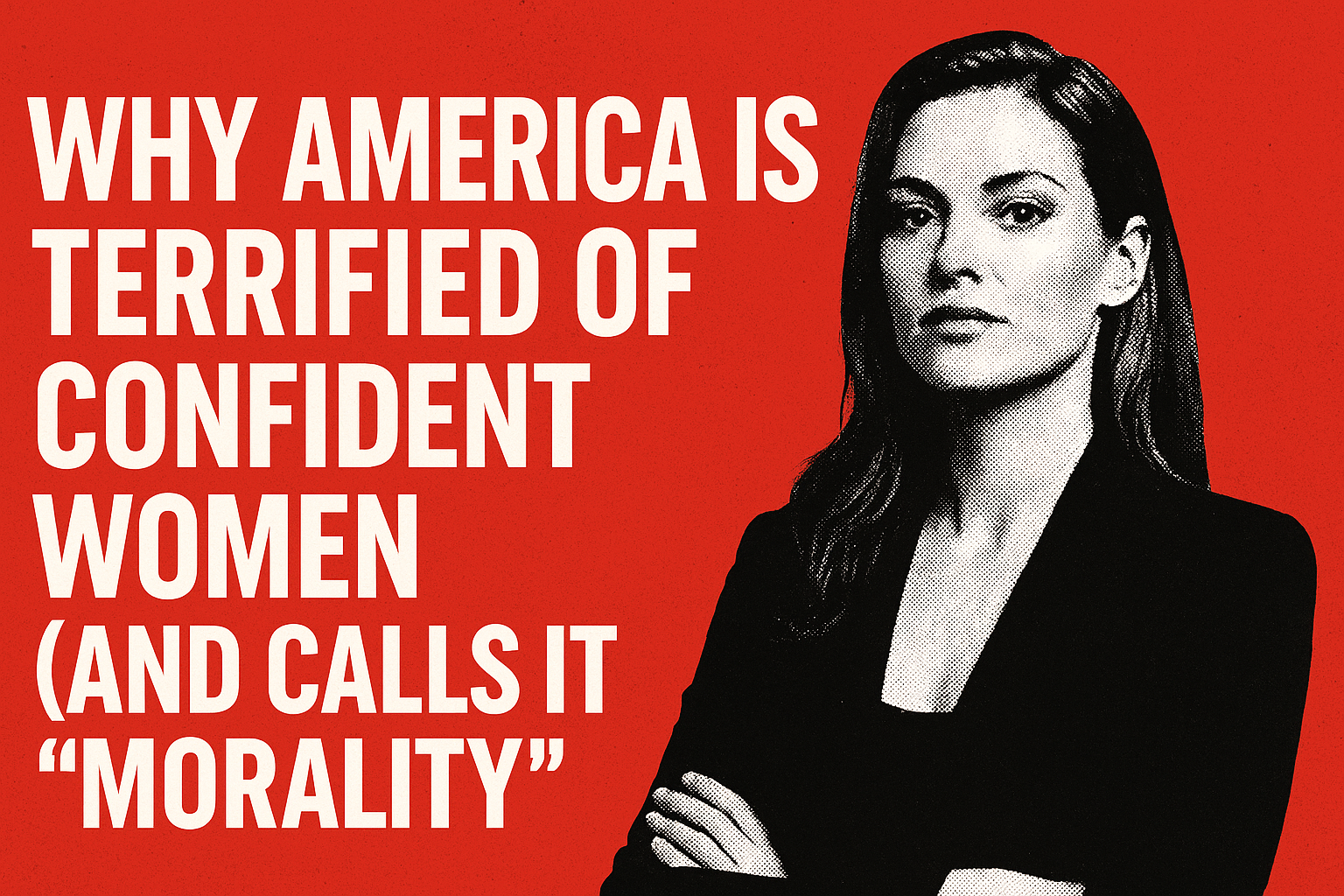
America claims to value strong women.
It just doesn’t like them when they act like it.
The moment a woman is visibly confident—about her body, her voice, her ambition, or her pleasure—the tone shifts. She’s no longer “empowering.” She’s too much. Too loud. Too sexual. Too aggressive. Too intimidating.
And suddenly, the conversation becomes about morality.
That’s not coincidence. It’s control.
Morality Is How Discomfort Gets Dressed Up
When America panics about “values,” it’s rarely talking about ethics. It’s talking about power.
Confident women don’t defer. They don’t ask permission. They don’t shrink to be liked. And systems built on hierarchy—especially patriarchal ones—don’t know what to do with women who won’t stay in their place.
So instead of saying “This makes us uncomfortable,” the culture says:
- She’s inappropriate
- She’s setting a bad example
- She lacks decorum
- She’s immoral
Morality becomes the language of fear.
The Confidence Double Standard
Men are rewarded for confidence.
Women are punished for it.
Confidence in men is leadership.
Confidence in women is arrogance.
Women are encouraged to be confident—but only in carefully limited ways:
- Be confident, but agreeable
- Be sexy, but not sexual
- Be ambitious, but not threatening
- Be strong, but still accommodating
The second a woman refuses to soften herself for public consumption, the backlash begins. Her clothes are scrutinized. Her tone is policed. Her past is weaponized. Her body becomes public property.
Why Female Sexuality Triggers Moral Panic
Nothing exposes this fear faster than women who own their sexuality.
A woman with sexual agency destabilizes a system that depends on her shame. If she doesn’t need permission, protection, or validation, control becomes harder to justify.
So sexuality is framed as danger:
- It corrupts children
- It destroys families
- It erodes society
Yet male sexuality is routinely excused as natural or inevitable. The issue isn’t sex—it’s agency.
Women choosing for themselves has always been the real threat.
Politics Is Where the Fear Shows Its Teeth
In politics, confident women are punished in real time.
Their ambition is called selfish.
Their certainty is labeled hysteria.
Their boundaries are framed as hostility.
If they show emotion, they’re unstable.
If they show none, they’re cold.
If they refuse to apologize, morality suddenly matters.
This is why “family values” rhetoric resurfaces whenever women gain ground. It’s not nostalgia—it’s containment.
What America Is Actually Protecting
America isn’t protecting morality. It’s protecting a power structure.
Confident women challenge:
- Who gets to lead
- Who gets to speak
- Who gets to desire
- Who gets to decide
And when those boundaries feel threatened, power doesn’t argue—it moralizes.
Calling confident women immoral is easier than admitting fear.
The Price Women Pay for Shrinking
Many women learn early that confidence must be diluted with humor, apologies, or self-deprecation to be acceptable.
The cost is enormous:
- Fewer women in leadership
- Fewer women shaping policy
- Fewer girls who believe they can exist unapologetically
A culture that fears confident women is a culture afraid of its own progress.
The Truth Behind the Panic
Confident women aren’t dangerous because they’re immoral.
They’re dangerous because they’re uncontrollable.
They don’t wait to be chosen.
They don’t accept shame as the entry fee.
They don’t ask permission to take up space.
And systems built on obedience have always feared that.
Final Word
Confidence is not a character flaw.
It’s only a problem for people who benefit from silence.
Every time America hides its discomfort behind “morality,” it reveals exactly what it’s afraid of:
Women who know who they are—and refuse to apologize for it.