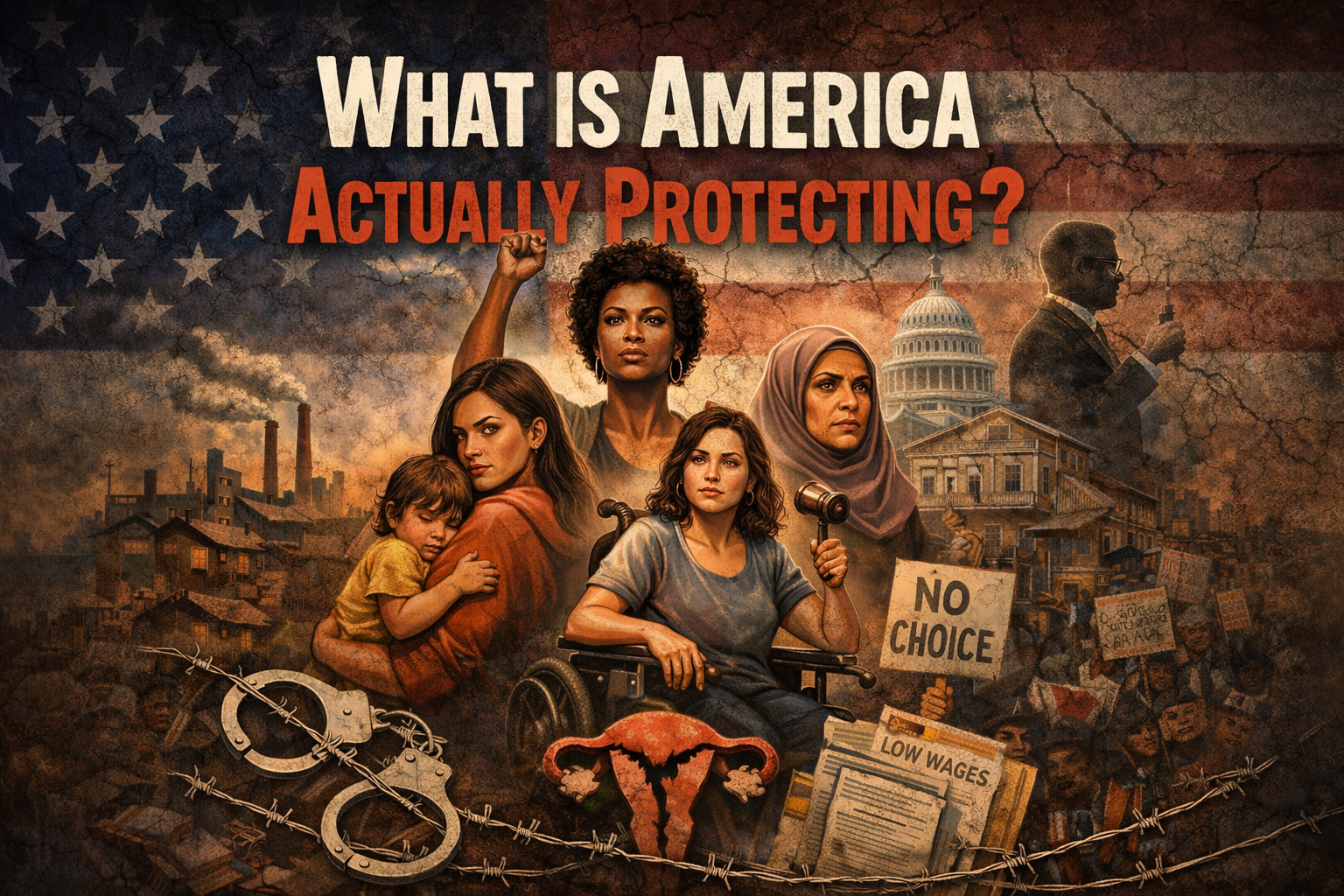
America says it is protecting freedom. Tradition. Family values. Safety.
But when you trace what policies defend most aggressively and whose autonomy is treated as dangerous, a quieter truth surfaces. Much of what America is protecting is not stability or morality. It is the hierarchy that keeps power concentrated and, very often, keeps women from fully having it.
Power Framed as a Threat
Women’s power is routinely described in the language of fear.
Too emotional. Too radical. Too selfish. Too ambitious.
When women demand control over their bodies, it is called reckless. When they demand equal pay, it is called unrealistic. When they refuse motherhood or redefine it on their own terms, it is framed as a social crisis.
Power held by women is rarely treated as neutral. It must be justified, limited, supervised, or softened so it does not disrupt the existing order.
Protection as Control
Many policies marketed as protection function instead as containment.
Restrictions on reproductive healthcare are framed as protecting life, while ignoring the lives of women forced to carry pregnancies at great physical, emotional, and economic cost.
Workplace structures are defended as merit-based, even as they penalize caregiving, pregnancy, and any body that cannot perform uninterrupted labor.
Family policy assumes women will absorb risk privately. If something goes wrong, if a child is disabled, if care is needed, if income drops, the system does not bend. The woman is expected to.
Protection, in this context, means protecting institutions from having to change.
The Fear Beneath the Rhetoric
At the heart of these debates is an anxiety about agency.
A woman who controls her fertility controls her future.
A woman with economic independence can leave.
A woman with political power can rewrite rules that once relied on her unpaid labor and silence.
These shifts threaten systems built on the assumption that women will provide care, emotional labor, and stability without demanding power in return.
So America protects the stories that keep that arrangement intact. That motherhood is destiny. That sacrifice is virtue. That asking for more is greed.
Whose Freedom Counts
American freedom is often defined as freedom from interference, but only for some.
The freedom of employers to avoid paid leave outweighs the freedom of women to recover from childbirth without financial ruin.
The freedom of lawmakers to moralize outweighs the freedom of women to make medical decisions.
The freedom of tradition outweighs the freedom to build new family structures that reflect modern realities.
Women’s freedom is treated as conditional, acceptable only when it does not disrupt markets, power, or male comfort.
Care Without Power
Caregiving reveals this imbalance most clearly, and it is not experienced equally.
Women are expected to care for children, aging parents, disabled family members, and communities. But race, disability, and class determine how punishing that expectation becomes. Middle- and upper-class women may be able to purchase help, reduce work hours, or access private services. Poor women, disproportionately women of color, are far more likely to absorb this labor alone while being surveilled, judged, and penalized for it.
Disabled women are often excluded entirely from narratives of caregiving and autonomy. They are treated as dependents rather than decision-makers, their reproductive choices questioned, their capacity doubted, their needs framed as burdens rather than rights.
When caregivers ask for support, they are told to be resilient, grateful, or more organized. The system remains untouched.
America protects the idea that care is a private responsibility rather than public infrastructure. That belief depends on women continuing to do the work without gaining leverage.
A Personal Reckoning With Protection
As a mother, I see these dynamics not as abstractions but as daily negotiations.
Motherhood is often held up as proof that women already have power, that our influence is moral rather than political. But caregiving without agency is not power. It is obligation.
When your child needs supports the system will not reliably provide, you are told to advocate harder. When care disrupts your ability to work, you are told to plan better. When exhaustion sets in, you are told this is simply what love looks like.
There is no serious protection for mothers navigating disability, economic precarity, or inadequate public systems. Instead, there is an expectation that women will stretch themselves thinner, quietly, indefinitely.
This is not accidental. It is how a society preserves the appearance of functioning while refusing to invest in the people holding it together.
What Is Actually Being Preserved
America is protecting a social order where women’s labor is essential but undervalued.
Where women’s bodies are political terrain.
Where women’s ambition is acceptable only when it does not challenge male dominance.
Where equality is promised in theory but rationed in practice.
This is not accidental. It is the outcome of policies designed to maintain comfort for those already in control.
What Real Protection Would Require
Real protection would mean trusting women with power.
It would mean guaranteeing reproductive autonomy without apology.
Valuing caregiving as public work.
Designing economies that account for bodies, families, and lives as they actually exist.
It would mean accepting that when women gain agency, some old systems must fall.
The Question We Keep Avoiding
So when America says it is protecting something, we should ask what and who.
Are we protecting life, or protecting control?
Are we protecting families, or protecting a hierarchy that depends on women’s sacrifice?
Are we protecting freedom, or protecting fear of women who no longer ask permission?
Until those questions are answered honestly, protection will remain a slogan. And women’s power will continue to be treated as something America needs saving from, rather than something it desperately needs.