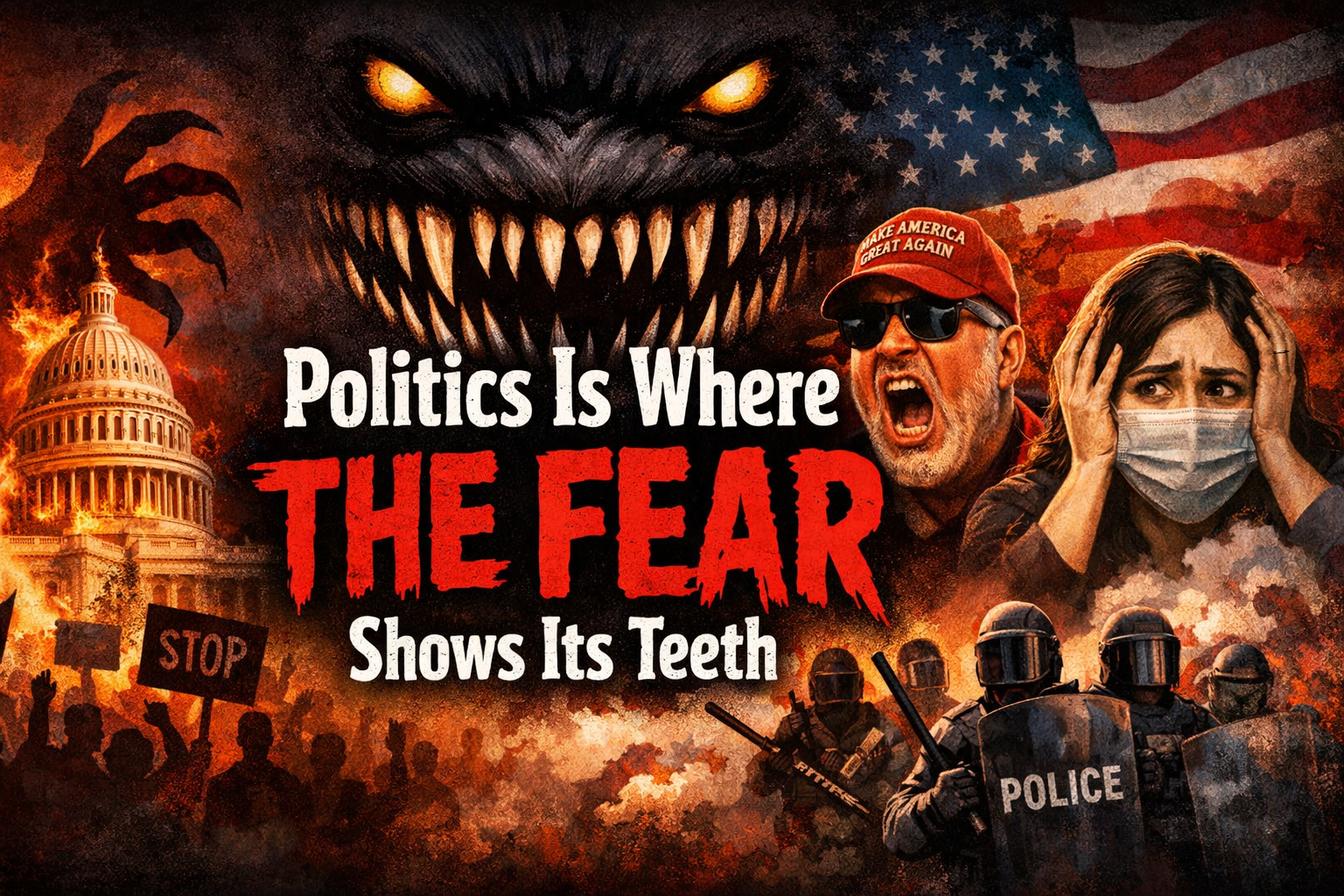
Politics likes to pretend it is about budgets, borders, and ballots. It dresses itself up in spreadsheets and soundbites, insisting it is rational, pragmatic, unavoidable. But scratch the surface, listen closely to the volume and the venom, and you find something far less tidy underneath. Politics is where fear shows its teeth.
Not fear in the abstract. Not the cinematic kind with villains and villains’ lairs. This is a specific, targeted fear. Fear of losing power. Fear of losing control. Fear of being forced to reckon with a world that no longer centers the same people it always has.
When politicians talk obsessively about “law and order,” “family values,” or “protecting women and children,” they are rarely describing a real threat. They are naming a discomfort. They are reacting to shifts in who is allowed agency, credibility, and autonomy. Fear bares its teeth when it feels its dominance slipping.
Fear Loves a Scapegoat
Fear is inefficient on its own. It needs a vessel. So politics supplies one.
Women who refuse prescribed roles become dangerous. Black and brown communities become threats rather than neighbors. Disabled people asking for access are framed as burdens. Poor people demanding dignity are accused of dependency. Queer and trans people existing openly are cast as destabilizing forces. Immigrants are painted as invaders. Each group becomes a stand-in for the same underlying anxiety: what happens if power is no longer hoarded by the few?
This is why so many political fights fixate on bodies rather than systems. Abortion bans. Bathroom bills. Attacks on gender-affirming care. Policing what books children can read. Restricting how history is taught. It is easier to legislate fear onto bodies than to confront the economic and social structures that actually create instability.
Fear does not want solutions. It wants containment.
Respectability as a Weapon
One of fear’s favorite disguises is respectability. Calls for “civility” emerge precisely when marginalized people grow louder. Appeals to “norms” surface when those norms no longer serve everyone equally. Morality becomes a bludgeon, used to shame people back into silence.
This is deeply intersectional. Women of color are punished more harshly for anger. Disabled people are expected to be grateful rather than demanding. Poor mothers are scrutinized in ways wealthy parents never are. Respectability politics is not about behavior; it is about reminding people of their place.
And politics rewards this. Campaign ads stoke outrage while scolding those harmed for being “too emotional.” Legislators pass cruel policies and then clutch pearls at the public’s reaction. Fear bites, then insists it is the victim.
The Personal Is Not a Metaphor
As a mother and caregiver, I see how this fear operates up close. Caregiving exposes the lie at the heart of our political culture: that independence is the highest virtue and dependence is a failure. Children, disabled people, elders all disrupt this myth simply by existing. They require care, resources, patience, and collective responsibility.
Instead of meeting that reality, our politics punishes it. Parents are told to do more with less. Caregiving is privatized, feminized, and devalued. When families struggle, the blame is personal, never structural. Fear shows its teeth here too, snapping at the idea that we owe each other anything at all.
What terrifies power is not weakness. It is interdependence. A society that admits we need one another is a society that might start demanding public investment, shared responsibility, and accountability from those at the top.
Why the Volume Keeps Rising
If it feels like political rhetoric is getting louder, harsher, more unhinged, that is because fear is losing its subtlety. The dog whistles are becoming air horns. The cruelty is no longer coded; it is celebrated. When people cheer policies that harm children, migrants, or disabled communities, they are not confused. They are afraid, and fear has convinced them that hurting others will keep them safe.
But fear is a terrible architect. It builds walls instead of futures. It consumes itself, always needing a new enemy, a new outrage, a new group to blame.
Choosing Something Better
Politics does not have to be where fear shows its teeth. It could be where we name fear honestly and refuse to let it drive. That would require listening to the people most impacted. It would require valuing care as infrastructure, dignity as policy, and equity as a baseline rather than a threat.
Fear thrives on silence and isolation. It weakens when confronted with solidarity and truth.
The question is not whether fear exists in our politics. It always will.
The question is whether we keep letting it bite.